
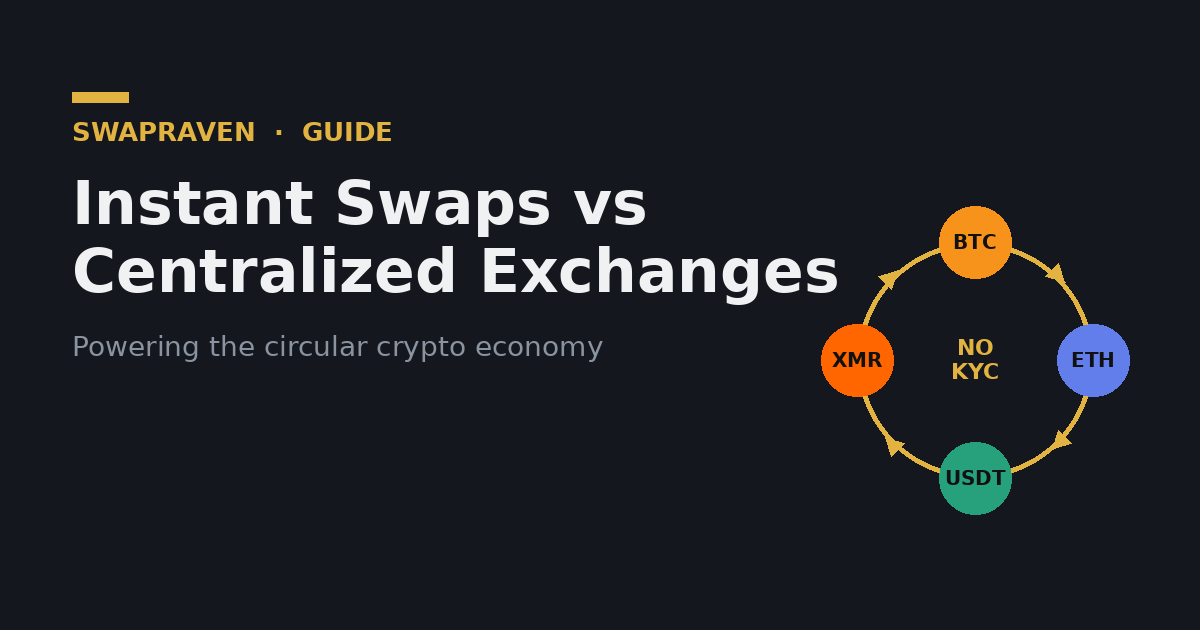
If you want to move between coins, you have two very different tools: a centralized exchange (CEX) where you open an account, verify your identity, and trade on an order book — or an instant swap that converts one coin to another and sends it straight to your wallet, with no account and no KYC by default. They can both get you from coin A to coin B, but they serve different purposes — and that difference is exactly what makes instant swaps the engine of a circular crypto economy. This guide explains why you'd reach for an instant swap over a CEX, and how that choice keeps value flowing inside crypto instead of leaking back out to the banking system.
This is general educational content, not financial advice. You're responsible for your own keys, taxes, and local compliance.
The two models, side by side
A centralized exchange
A CEX is a custodial venue: you deposit funds to their wallet, pass identity verification, and trade balances they hold on your behalf. It's the standard on-ramp — buy crypto with a card or bank transfer — and it offers deep liquidity and order books. The trade-off: you create an account tied to your identity, the exchange custodies your coins while they're there ("not your keys, not your coins"), and your activity becomes a permanent record. See The Hidden Risks of CEX KYC.
An instant swap exchange
An instant swap is non-custodial and address-based: no account, no order book, and no KYC by default. You pick the pair, paste the receiving address you control, send your deposit, and the service converts and forwards the result to your wallet — usually in minutes. There's nothing to log into and no balance sitting on the platform. New to the model? Start with What is an Instant Swap Exchange?
The purpose of using an instant swap over a CEX
- Self-custody, always. Your coins live in your own wallet before and after the swap — they only touch the service for the moments it takes to convert. Nothing is held for you, so there's no account to be frozen and no balance to lose if the platform has a bad day.
- No account, no identity honeypot. You're not handing over ID, a selfie, and proof of address to be stored forever. That removes a whole category of risk — data breaches, phishing, and deanonymization of your holdings.
- Reach any coin. Swaps quote pairs that big exchanges won't list — including privacy coins like Monero — so you're not limited to whatever a regulated venue chooses to offer.
- Speed and simplicity. No deposit-confirm-trade-withdraw cycle. One send, one receive, done.
- Privacy by routing. Because each swap pays out to a fresh address you control, you can break the on-chain trail — especially when you route through a privacy coin (see Chain Hopping for Privacy).
In short: a CEX is built around holding your funds and your identity; an instant swap is built around moving your funds and leaving you in control.
How this powers the circular crypto economy
A circular economy is one where value keeps circulating inside the system instead of being cashed out. In crypto terms: you earn in crypto, spend in crypto, save in crypto, and move between coins as needed — without round-tripping through a bank every time. Instant swaps are the connective tissue that makes that loop work:
- No forced fiat off-ramp. To use a CEX you generally pull value out to a bank-linked, KYC'd account. Instant swaps let you convert crypto to crypto and keep it in the ecosystem — value never has to leave to be useful.
- Pay anyone in the coin they want. Hold BTC but need to pay an invoice in XMR or USDT? Swap it straight to the recipient's address. That interoperability lets merchants, freelancers, and peers transact across coins without everyone agreeing on one. See How to Pay for Anything With Instant Swaps.
- Privacy coins stay usable. The circular economy depends on fungible, private money. Swaps are the bridge that lets people get into and out of Monero without a delisting-prone CEX standing in the way (Monero delistings).
- Lower friction, more velocity. No accounts to open per service means value moves faster and more freely between wallets, apps, and people — which is exactly what a healthy circular economy needs.
- Censorship-resistant. There's no account to suspend, so the loop keeps turning even for users a regulated exchange would rather not serve.
When a CEX still makes sense
This isn't "never use a centralized exchange." A CEX is still the most convenient on-ramp to turn fiat into crypto, and a useful off-ramp when you genuinely need a bank again. The healthy pattern is simple: buy on a regulated exchange like Coinbase or Kraken, withdraw to a wallet you control (see How to Buy on a CEX and Withdraw to Your Own Wallet), and from then on use instant swaps to move between coins. The CEX gets you in; instant swaps keep you moving — privately, in self-custody, inside the economy.
Use an instant swap the right way
- Hold your own keys. Pick a good self-custody wallet first — see The Best Wallets for Instant Swaps.
- Never swap straight from a CEX. Withdraw to your wallet, then swap — sending exchange→swap re-links your identity and can break refunds (more in Common Mistakes People Make With Instant Swaps).
- Choose the right rate. Fixed locks the amount; floating is usually a touch cheaper (Fixed vs Floating Rates).
- Use a fresh receiving address each time, and verify the deposit address by eye.
Find a swap on SwapRaven
A centralized exchange holds your funds and your identity; an instant swap just moves your money and hands you back the keys — which is precisely why swaps keep value circulating inside crypto instead of leaking out to a bank. SwapRaven grades no-KYC instant swap exchanges on trust, fees, supported coins, and KYC/AML posture. Browse the directory — or jump straight to the best-rate finder — to compare exchanges for the pair you want and swap into your own wallet, no account required.
Comments (0)
Leave a comment