
Every time you start an instant swap, you choose between a fixed rate and a floating rate. It's a small decision with real consequences: it determines whether you know the exact amount you'll receive, who absorbs the market risk while the transaction settles, and how much you pay in fees. This guide explains exactly what each rate type does, why the difference matters, and when to pick one over the other — with concrete use cases. If you want the payment-focused angle, pair this with How to Pay for Anything With Instant Swaps.
What the two rate types actually do
Fixed rate
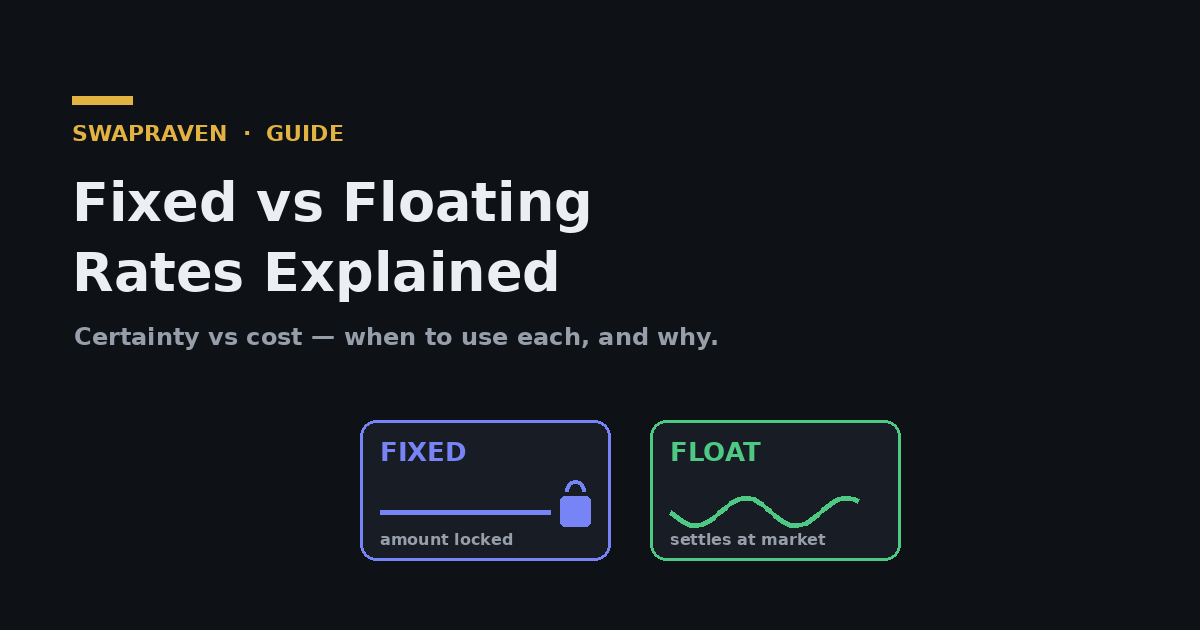
With a fixed rate, the amount you'll receive is locked the moment you start the swap. The service guarantees that output for a limited time window, regardless of how the market moves while your deposit confirms. To provide that guarantee, the exchange takes on the price risk itself — so a fixed rate usually costs a slightly higher fee, and the quote expires if your deposit doesn't arrive in time.
Floating rate
With a floating rate, the price is finalized when your deposit confirms, not when you start. You receive whatever the market rate is at settlement, so the final amount can move up or down between starting the swap and it completing. Because you carry the market risk, a floating rate is usually cheaper.
Why the difference matters
It comes down to two things: certainty and who bears the risk. A fixed rate buys you a guaranteed output amount at the cost of a small premium and a time limit. A floating rate saves on fees but leaves the final amount uncertain until the transaction settles. Neither is "better" — they're tools for different jobs.
When to use a fixed rate
- You're paying an exact amount. Invoices, merchants, or anyone who needs a precise figure — a fixed rate guarantees they receive exactly what's owed. (See How to Pay for Anything With Instant Swaps.)
- The market is volatile. When prices are swinging, locking the output protects you from an unfavorable move while the swap settles.
- You're swapping a slow-confirming coin. If your input takes a while to confirm, a fixed rate stops the price from drifting during that wait.
- Certainty matters more than a small fee. When you simply want to know the exact number, pay the premium and lock it.
When to use a floating rate
- You want the lowest fee and can tolerate a little variance in the output.
- Confirmations are fast and the market is calm. With a quick-settling coin and stable prices, there's little risk for the rate to drift, so floating captures the savings.
- The exact amount doesn't need to be precise. Swapping for your own wallet, where a small difference up or down is fine.
- You're moving a routine amount and just want the going rate.
Fixed vs floating at a glance
- Output amount: fixed = guaranteed; floating = settles at market.
- Fee: fixed = slightly higher; floating = usually lower.
- Market risk: fixed = the exchange bears it; floating = you bear it.
- Time pressure: fixed = must deposit within the lock window; floating = more forgiving, but drift grows the longer it takes.
- Best for: fixed = payments and volatile/slow swaps; floating = cheap, routine self-swaps.
Practical tips either way
- On a fixed rate, send promptly and use an adequate network fee so your deposit lands inside the lock window. If it expires, the swap usually refunds or re-quotes.
- On a floating rate, still send quickly — a faster confirmation means less time for the price to drift.
- Always set a refund address you control, for either type.
- Avoid the common pitfalls (units, networks, memos, address verification) — see Common Mistakes People Make With Instant Swaps.
Choose a swap that offers both on SwapRaven
Good services let you pick the rate type that fits the job. SwapRaven grades instant swap exchanges and aggregators on trust, fees, supported coins, and KYC/AML posture, so you can find one that supports your pair with the rate options you need. Browse the directory to find a vetted, no-KYC instant swap — then pick fixed or floating with confidence.
Comments (0)
Leave a comment