
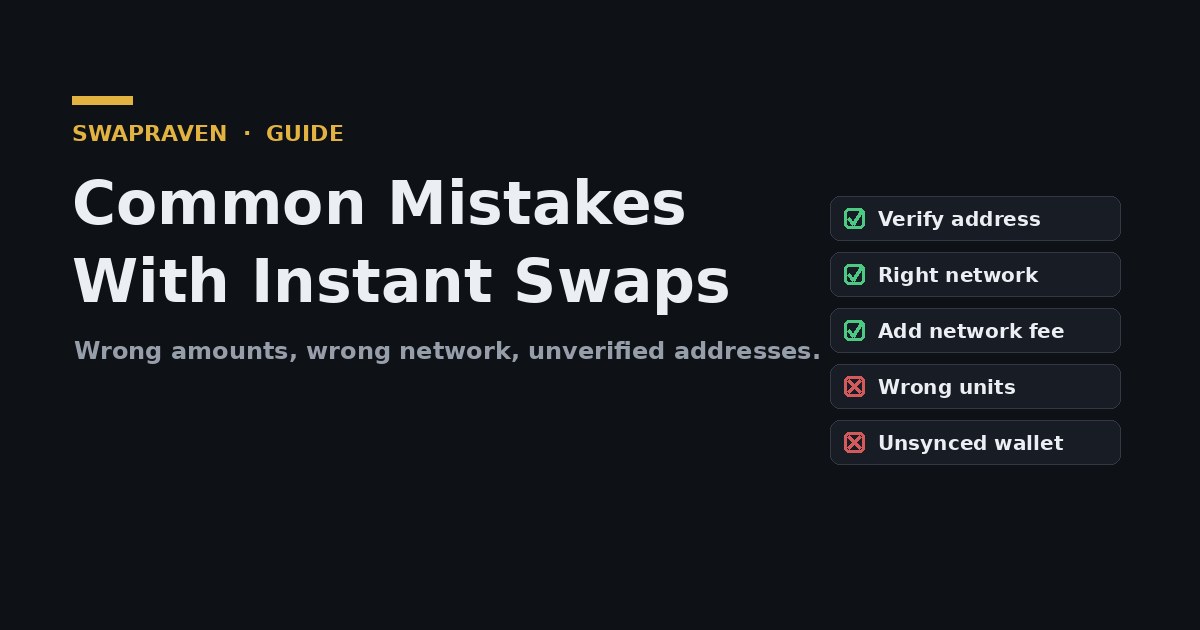
Instant swaps are simple, but because crypto transactions are irreversible, small mistakes can cost you time, money, or the whole swap. The good news: nearly every problem comes from the same short list of avoidable errors. This guide walks through the most common mistakes people make with instant swaps — wrong amounts, missing network fees, unsynced wallets, wrong networks, bad addresses, and timing slip-ups — and exactly how to do each one right. If you're new to the process, read it alongside How to Use an Instant Swap Exchange.
1. Sending the wrong amount (unit confusion)
This is the classic. People mix up units and send far more or far less than they meant:
- millibitcoin (mBTC) vs BTC vs sats. 1 BTC = 1,000 mBTC = 100,000,000 sats. A wallet showing "mBTC" can trick you into sending 1,000× too little — or too much.
- gwei vs ETH, and tokens with different decimal places, cause the same trap.
Do it right: set your wallet's display unit to whole coins (BTC, ETH) before you send, and confirm the amount matches the swap quote exactly.
2. Forgetting network fees
If a swap asks you to send 0.01 BTC and you send "0.01 BTC" with the network fee taken out of that, the exchange receives slightly less than 0.01. That underpayment can drop you below the swap's minimum and trigger a delay, a refund, or a re-quote at a worse rate.
Do it right: send the exact amount the swap expects to receive, with the network fee added on top — not subtracted from it. Many wallets let you choose; double-check the recipient gets the full quoted amount.
3. Not syncing your wallet before sending
Some wallets — Monero especially — must sync to the latest blocks before they can build and broadcast a transaction correctly. Sending from an out-of-date wallet can fail, stall, or show the wrong balance.
Do it right: let the wallet finish syncing first. If you run your own node, make sure it's caught up before you pay.
4. Choosing the wrong network
Many assets exist on multiple chains. USDT, for example, lives on Ethereum (ERC-20), Tron (TRC-20), and TON. Sending on a different network than the deposit address expects usually means the funds are lost.
Do it right: confirm the exact network on both sides — your wallet's send network must match the swap's deposit network, character for character on the chain name.
5. Missing the memo, tag, or destination ID
Some coins (XRP, and certain exchange deposits on chains like TON or Cosmos) require a memo/tag alongside the address. Leave it out and the deposit may be unattributed or stuck.
Do it right: if the swap shows a memo/tag/destination ID, include it exactly as shown, in the right field.
6. Sending to the wrong address (and trusting QR codes blindly)
Pasting the wrong address, an old clipboard value, or a malware-swapped address sends your funds into the void. QR codes feel safe but can be tampered with or point somewhere unexpected.
Do it right: after pasting or scanning, verify the address manually — read the first and last several characters and confirm they match the swap's deposit address. Triple-check when using a QR code; scanning is not a substitute for reading the address with your own eyes. Beware clipboard-hijacking malware that silently replaces addresses.
7. Timing mistakes on floating rates
With a floating rate, the price is finalized when your deposit confirms. If you take too long to send, or the network is slow, the rate can move outside the allowed range and the swap may be refunded or re-quoted.
Do it right: send promptly after starting the swap, use an adequate network fee so it confirms in good time, or choose a fixed rate when you want the output locked in. (See fixed vs floating in How to Use an Instant Swap Exchange.)
8. Ignoring minimum and maximum limits
Send below the minimum and the swap can't process it; send above the maximum and it may be partially refunded or held for review.
Do it right: check the swap's min and max for your pair and keep your amount comfortably inside them.
9. No refund address — or a wrong one
If a swap can't complete, the service returns funds to your refund address. Skip it or enter it wrong and getting your money back becomes slow or impossible.
Do it right: always set a refund address to a wallet you control, ideally for the same coin you're sending.
10. Sending from a custodial exchange instead of self-custody
Sending the deposit directly from a CEX account (rather than your own wallet) can cause problems: the refund address won't be yours, exchanges sometimes batch or alter sends, and you lose privacy and control.
Do it right: swap from a self-custody wallet you control. (See The Best Wallets for Instant Swaps and How to Buy on a CEX and Withdraw to Your Own Wallet.)
The pre-send checklist
Before you hit send on any instant swap, confirm:
- Wallet is synced and shows the right balance.
- Amount is in the right unit (whole BTC/ETH, not mBTC/gwei) and matches the quote.
- Network fee is added on top, so the exchange receives the full quoted amount.
- Network matches on both ends; memo/tag included if required.
- Deposit address verified by eye — first and last characters — even if you scanned a QR.
- Amount is within min/max; a refund address you control is set.
- Sending from your own wallet, promptly, with a fixed rate if you want certainty.
Swap with confidence
Avoid these mistakes and instant swaps are fast, private, and reliable. The other half of a smooth swap is choosing a reputable service: SwapRaven grades instant swap exchanges on trust, fees, supported coins, and KYC/AML posture. Browse the directory to find a vetted, no-KYC instant swap and do it right the first time.
You could add an 11th point: also send to self-custody, not to an exchange deposit address. We've seen cases where the destination wallet was a custodial exchange address, and the exchange rejected the incoming funds — bouncing them back to the swap service. That refused-and-returned cycle can create real headaches (delays, and in some cases funds getting stuck if the swap's return logic doesn't handle it cleanly). Point #10 covers not sending from an exchange — it's worth stressing that the same logic applies to the receiving side too: use a wallet you control as the destination whenever possible.