
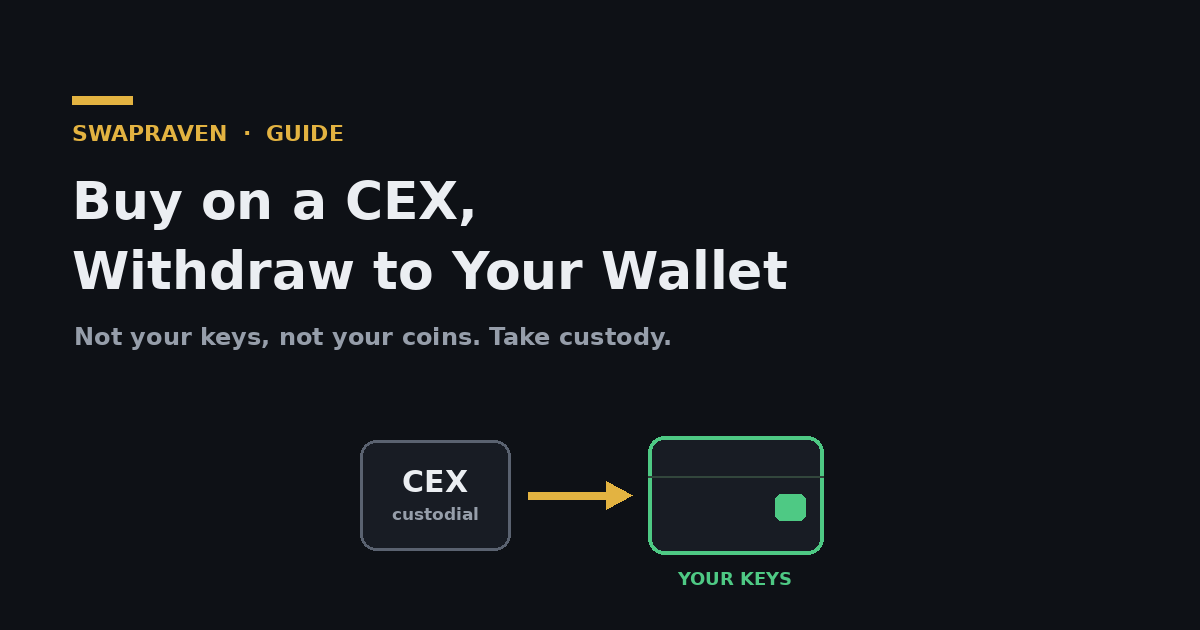
For most people the easiest way to turn cash into crypto is a regulated centralized exchange (CEX) like Coinbase or Kraken. They take your bank transfer or card and give you Bitcoin or Ethereum in return. But there's a catch most newcomers miss: while your coins sit on the exchange, they aren't really yours — the exchange holds the keys. The smart workflow is to buy on a CEX, then withdraw to a wallet you control, and from there use instant swaps to reach any coin you want, privately. This guide shows how, and why that withdrawal step matters so much.
Not your keys, not your coins
When you hold crypto on a CEX, the exchange controls the private keys — you just have an IOU on their books. That means they can, and sometimes do:
- Freeze or limit your account for review, compliance, or region changes — locking you out of your own funds.
- Block or delay withdrawals, impose limits, or require extra verification at the worst moment.
- Seize or garnish balances under legal orders, or delist coins you hold (privacy coins especially).
- Lose your funds in an insolvency — if the exchange fails, customer balances can be gone, as history has repeatedly shown.
Withdrawing to your own wallet ends that dependency. Once the coins are in self-custody, no company can freeze, seize, or lose them on your behalf — the keys are yours.
The workflow: buy on a CEX, withdraw, then swap
- Buy a liquid coin on the CEX. Use Coinbase or Kraken to buy Bitcoin or Ethereum with fiat — these withdraw cheaply and are accepted everywhere.
- Set up a wallet you control. Create a self-custody wallet and back up the seed phrase before you move anything. (See The Best Wallets for Instant Swaps for the right wallet per coin, plus seed-phrase safety.)
- Withdraw from the CEX to your wallet. Send your BTC or ETH to a fresh address from your own wallet (steps below).
- Swap to anything from self-custody. With coins in your own wallet, use a no-KYC instant swap to reach coins the CEX doesn't list — like Monero — without an account. (See What is an Instant Swap Exchange? and Using Instant Swaps to Get Monero.)
This combines the best of both worlds: the CEX is a convenient fiat on-ramp, and instant swaps give you reach and privacy once you're in control of your keys.
How to withdraw from Coinbase
- In your wallet, tap Receive and copy a fresh address for the coin you bought (e.g. Bitcoin).
- On Coinbase, choose Send / Withdraw, select the asset, and paste your wallet address.
- Confirm the network matches (e.g. send Bitcoin on the Bitcoin network, not a wrapped version).
- Start with a small test amount the first time. Once it arrives, send the rest.
How to withdraw from Kraken
- Copy a fresh receiving address from your wallet for the asset you hold.
- On Kraken, go to Withdraw, pick the asset, and add your address as a withdrawal recipient.
- Double-check the network and any address whitelist confirmation Kraken asks for.
- Withdraw a small amount first to confirm everything works, then move the balance.
Withdrawal tips that prevent lost funds
- Verify the address character by character after pasting — check the first and last few characters. Crypto transactions are irreversible.
- Match the network on both ends. Sending on the wrong chain (e.g. an ERC-20 to a Bitcoin address) loses the funds.
- Account for the withdrawal fee. The CEX deducts a network fee, so you'll receive slightly less than the amount you entered.
- Use a fresh address from your own wallet for privacy.
- Test small, then send the rest — every single time with a new wallet or exchange.
Then take control with instant swaps
Once your BTC or ETH is safely in your own wallet, you're no longer at the mercy of any exchange — and you can swap into other coins on your terms. SwapRaven grades no-KYC instant swap exchanges on trust, fees, supported coins, and privacy features so you can pick a good one. Browse the directory, then swap straight from your self-custody wallet — your keys, your coins, no account required.
Comments (0)
Leave a comment