
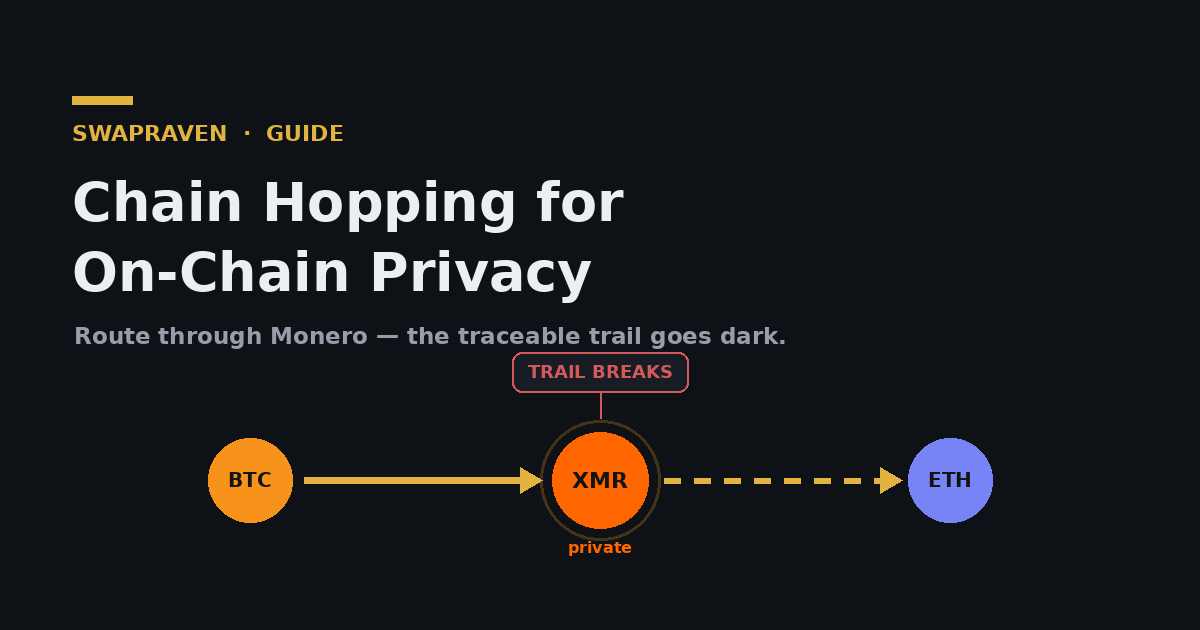
Every public blockchain is exactly that — public. Bitcoin and Ethereum transactions sit on a permanent, transparent ledger that anyone, including professional chain-analysis firms, can read and cluster. One of the most effective ways ordinary people regain on-chain privacy is chain hopping: using cross-chain instant swaps to move funds across different blockchains — and especially through a privacy-focused coin like Monero — so the traceable trail on any single chain is broken. This article explains how cross-chain swaps help privacy, the honest limits of the technique, and why getting your funds into a privacy coin gives you so much more freedom with your own money.
This is a privacy guide for lawful users. Financial privacy is a legitimate goal — protecting yourself from profiling, theft, and surveillance — not a tool for evading taxes or laws.
What is chain hopping (cross-chain swapping)?
Chain hopping means moving value from one blockchain to another rather than keeping it on a single chain. With instant swap exchanges, this is simple: you swap, say, Bitcoin for Monero, then later Monero for Ethereum, each step delivered to a wallet you control on a different chain. Because each blockchain is a separate ledger, your funds don't carry one continuous, linkable history across all of them. New to swaps? See What is an Instant Swap Exchange?
How cross-chain swaps protect your privacy
Chain-analysis works by clustering addresses and following funds along a single transparent chain. Two things disrupt that:
- The chain boundary. When funds leave one chain and arrive on another via a swap, there is no on-chain link between the two transactions — only the swap service sits in the middle. An analyst watching the Bitcoin chain simply sees coins go to a swap; they can't follow them onto the next chain from the ledger alone.
- The privacy-coin black box. This is the powerful part. When you swap into Monero, the funds enter a chain where amounts, senders, and receivers are hidden by default. Once your value is inside Monero, the trail goes dark — and when you later swap out to another coin, the new coins have no traceable connection to whatever you started with.
That's why routing through a privacy coin is far stronger than hopping between two transparent chains: Monero doesn't just hide the boundary, it severs the deterministic link entirely. (For getting BTC this way, see How to Get Bitcoin Without KYC; for XMR, see Using Instant Swaps to Get Monero.)
Be honest about metadata
Chain hopping is powerful, but it isn't a magic invisibility cloak — and good privacy means understanding the limits:
- Endpoints still exist. If you bought the original coin on a KYC exchange and later cash out on one, those endpoints are recorded even if the middle is private.
- Timing and amount correlation. Hops between two transparent chains can sometimes be correlated by matching amounts and timing — which is exactly why routing through Monero (where amounts are hidden) matters.
- The swap service sees something. A no-KYC swap doesn't take your ID, but it may still see your IP and the addresses involved — so using Tor and reputable services helps.
The takeaway isn't "don't bother" — it's that the privacy coin in the middle is what does the heavy lifting. Get that part right and the residual metadata is dramatically less useful to anyone watching.
Once you hold a privacy coin, you're much freer
Here's the key insight: once your money is in a privacy coin, you have far more freedom in how you use it. On a transparent chain, every coin carries its entire public history, and that history follows you — it can be clustered, profiled, scored for "taint", or used to target you. Inside Monero, that baggage disappears:
- A clean slate. Funds in Monero aren't dragging a visible trail behind them, so you can spend, save, or swap out without your past activity being attached.
- Fungibility. Every unit of Monero is interchangeable — none is "tainted" by where it's been — which is how money is supposed to work.
- Move anywhere. From a privacy coin you can swap into whatever chain a situation calls for, arriving with no linkable history.
- Spend directly. Many merchants and services accept Monero, so you can often skip the trail entirely (see Cashing Out and Spending Your Crypto).
Why this matters
Financial privacy isn't about hiding wrongdoing — it's the normal expectation that strangers can't see your balances and spending. Transparent chains quietly erode that: leaked exchange data, address clustering, and public ledgers let others build a profile of your wealth and habits, which fuels everything from targeted phishing to physical threats (see The Hidden Risks of CEX KYC). Chain hopping through privacy coins puts that control back in your hands — it lets you use your own money without broadcasting your entire financial life to anyone with a block explorer.
Doing it well
- Route through a privacy coin (Monero) rather than hopping transparent-to-transparent — that's where the real protection comes from.
- Use no-KYC instant swaps so the hops don't tie back to your identity.
- Use fresh wallets and addresses for each step, and run your own node where you can (see The Best Wallets for Instant Swaps).
- Use Tor and avoid reusing identifiable amounts or predictable timing.
- Keep it clean and lawful — privacy and good hygiene go together (see How to Avoid KYC and AML Flags).
Find cross-chain swaps on SwapRaven
Chain hopping only works with services that support the pairs you need — especially swaps into and out of Monero. SwapRaven grades instant swap exchanges and aggregators on trust, fees, supported coins, and KYC/AML posture, so you can find ones that support the cross-chain routes you want. Browse the directory to find vetted, no-KYC swaps and take real control of your on-chain privacy.
Comments (0)
Leave a comment