
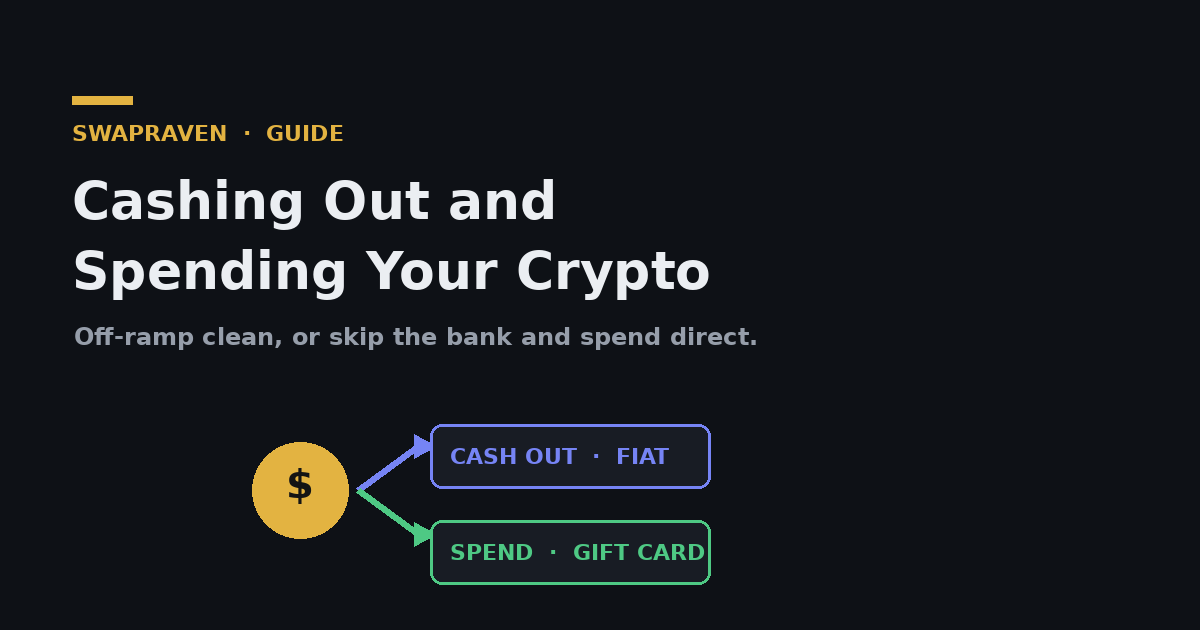
You've made some gains trading through instant swaps — now what? "Cashing out" doesn't have to mean dumping everything back into a bank account. You have two broad paths: convert crypto to fiat through a regulated exchange, or spend crypto directly on real goods and services without ever touching a bank. This guide covers both: how to cash out to fiat cleanly and safely through KYC exchanges (what to do and what to avoid), and the growing world of spending crypto directly — gift and prepaid cards, travel, hosting, VPNs, and merchant directories like Monerica and kycnot.me. The goal is a clear, practical map for turning instant-swap profits into things you actually want.
Path 1: Cashing out to fiat through a KYC exchange
If you need money in your bank, a regulated exchange like Coinbase or Kraken is the usual off-ramp. KYC is unavoidable here — that's the point of a fiat off-ramp — so the aim is to keep everything clean, documented, and boring to the compliance systems.
What to do
- Keep good records. Track what you bought, when, at what price, and what you sold. Clean records make taxes and any compliance questions painless.
- Use a reputable, licensed exchange in your jurisdiction, and complete its KYC properly with accurate details.
- Understand your tax obligations. In most countries, converting crypto to fiat (and sometimes crypto-to-crypto) is a taxable event. Declare gains; don't improvise.
- Move funds in normal, explainable amounts that match your documented activity.
- Screen coins before depositing. Deposit clean, well-sourced coins so an AML system has no reason to flag you (see How to Avoid KYC and AML Flags).
What to avoid
- Don't structure deposits or withdrawals into many small pieces to dodge thresholds — it's a red flag and, when deliberate, illegal.
- Don't deposit tainted coins (funds traced to thefts, mixers, or sanctioned sources) into a KYC exchange and hope; that's how accounts get frozen.
- Don't mix unrelated funds or route through a confusing chain of services right before cashing out — it looks evasive even when it isn't.
- Don't ignore the terms. Know the exchange's limits and policies before you move size.
Done this way, cashing out to fiat is simple and low-stress. But fiat isn't the only option — and often it isn't the best one.
Path 2: Spend crypto directly (skip the bank)
You can often skip cashing out entirely and spend crypto straight on goods and services. This keeps things simple, avoids off-ramp friction, and — when you use privacy-friendly options — keeps your spending private. Two directories are the best starting points for finding places that accept crypto:
- Monerica — a directory of businesses and services that accept Monero, organized by category, from shops and hosting to services and donations.
- kycnot.me — a directory that rates exchanges and services by how much KYC they require, so you can find no-KYC ways to swap and spend.
Gift and prepaid cards: the most popular way to spend
By far the most common way people spend crypto is by buying gift cards and prepaid (reloadable) cards. You convert crypto into store credit or a card balance, then spend it like cash at major retailers — no bank account involved. Popular services include:
- Bitrefill — gift cards and mobile top-ups for thousands of retailers worldwide, payable with several cryptocurrencies.
- Coinsbee — a large international gift-card marketplace accepting many coins.
Privacy note: gift cards are a practical way to spend without a bank, but they aren't automatically private — buying through a no-KYC service and using privacy-friendly coins matters if anonymity is your goal. A gift card to a major retailer still spends like that retailer; what you protect is the on-ramp, not the storefront.
Travel, hosting, domains, and VPNs
Plenty of real services take crypto directly — and several were privacy-minded from the start:
- Travel: platforms like Travala let you book hotels and flights with crypto, including privacy coins on some routes.
- VPNs: privacy-focused providers such as Mullvad and IVPN accept crypto (and sometimes cash), often with no account email required.
- Hosting and domains: a number of privacy-friendly hosts and registrars accept crypto, including Monero, so you can run sites and services without a card on file.
- Online stores and marketplaces: a growing list of merchants accept crypto directly — the Monerica directory is a good way to find ones that take Monero.
Putting it together
- Decide whether you actually need fiat, or whether you can spend crypto directly — often you can.
- To cash out: use a reputable KYC exchange, keep records, declare taxes, deposit clean coins, and don't structure.
- To spend: start with gift/prepaid cards for everyday retailers, and use Monerica and kycnot.me to find merchants and no-KYC services.
- Match your privacy to your goal — the protection comes from the on-ramp and the coins you use, not just the final store.
Swap, then spend — with SwapRaven
However you cash out, it starts with getting the right coins. SwapRaven grades no-KYC instant swap exchanges on trust, fees, supported coins, and KYC/AML posture, so you can swap into whatever you need — Bitcoin to cash out, Monero to spend privately — and then off-ramp or spend on your terms. Browse the directory to find a vetted instant swap and turn your gains into something real.
Comments (0)
Leave a comment