
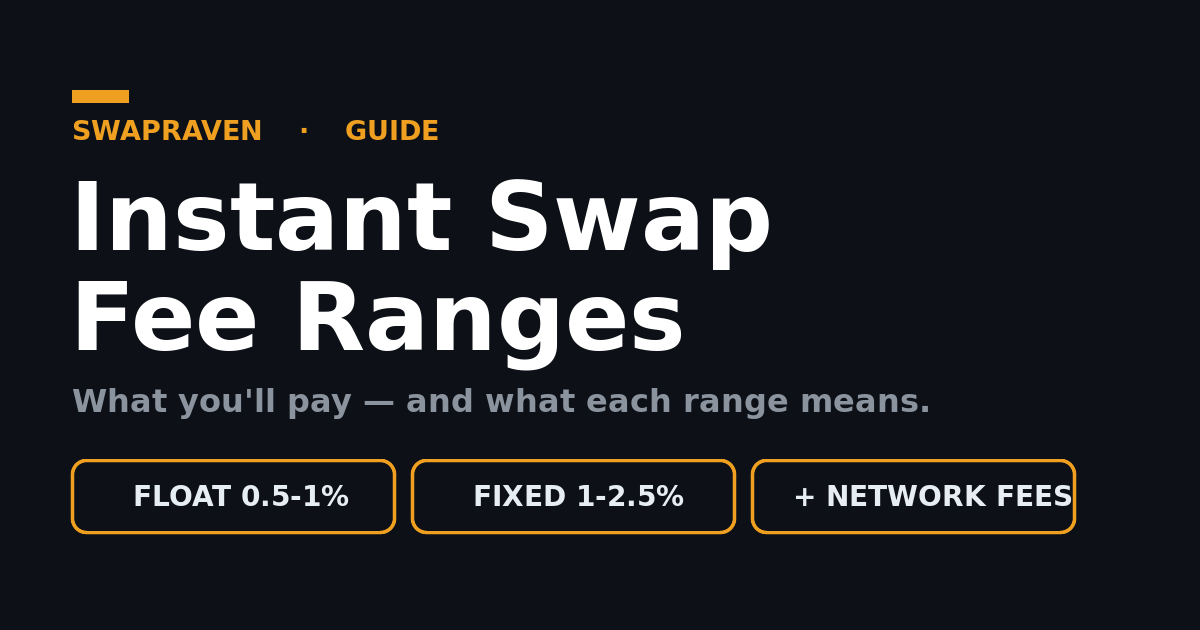
One of the most common questions about instant swaps is also one of the hardest to answer at a glance: what does it actually cost? Unlike a centralized exchange with a tidy "0.1% trading fee," an instant swap usually bakes its cost into the rate — so the number you care about is hidden in a spread. This guide lays out the typical fee ranges you'll see, what each range means, and what to realistically expect, so you can tell a fair quote from an expensive one.
This is general educational content, not financial advice. Fees vary by exchange, pair, amount, and market conditions; treat the ranges below as typical, not promises.
How instant swaps actually charge you
Most instant swaps don't show a separate "fee" line. Instead, their cost is the spread — the gap between the true market rate and the rate they quote you. On top of that sit the network fees for the on-chain transactions. So your all-in cost is really two things:
- The service spread — the exchange's margin, built into the rate.
- The network fees — what you pay to send your deposit, plus the payout fee the swap covers (and prices into the quote). See Network Fees Explained.
Because of that, the honest way to compare swaps is to look at how much you actually receive, not an advertised percentage.
Typical fee ranges — and what each means
Here's roughly what the spread tends to look like, and how to read it:
- Under ~0.5% — excellent. A very competitive floating-rate quote on a liquid pair (think BTC, ETH, LTC). If you're seeing this, you're getting a good deal.
- ~0.5%–1% — normal for a floating rate. This is the everyday range for a floating quote, where the final amount is set when your deposit confirms. Nothing to worry about.
- ~1%–2.5% — normal for a fixed rate. A fixed quote costs more because the exchange takes on the price risk of locking your amount up front. That premium over floating is essentially insurance against the rate moving. See Fixed vs Floating Rates.
- Above ~2.5%–3% — getting expensive. Worth a second look. It's often justified for illiquid or exotic pairs and some privacy coins, but on a major pair it's a sign to compare elsewhere.
What pushes the cost up
- Fixed vs floating. Fixed always costs more than floating for the same pair — you're paying for certainty.
- Pair liquidity. Major pairs are cheap; thin, exotic, or privacy-coin pairs carry wider spreads because the exchange hedges more risk.
- Small amounts. This is the big one people miss: on a tiny swap, the fixed network fees can dwarf the spread. A $20 swap might lose 10%+ to network fees even at a 1% spread, while the same fees are a rounding error on a $2,000 swap. Small swaps always look "expensive" in percentage terms.
- Volatility. In fast-moving markets, spreads widen — especially on fixed quotes.
What to expect, realistically
For a normal swap on a liquid pair, expect to lose somewhere around 0.5%–1% on a floating rate or 1%–2.5% on a fixed rate, plus network fees on both legs. Larger, liquid-pair swaps land at the low end; small or exotic swaps at the high end. If a quote is far outside these ranges on a major pair, that's your cue to compare — not to assume it's just "how it is."
How to get the best deal
- Compare what you'll receive, not the headline percentage — the all-in amount is the truth.
- Use floating for cost, fixed for certainty. If you can tolerate a little movement, floating is cheaper; if the exact figure matters, pay the fixed premium.
- Don't make tiny swaps when you can batch — fees eat a much smaller share of a larger trade.
- Mind the network fee, and pay only enough to confirm in time — see Network Fees Explained.
Compare real rates on SwapRaven
Because the cost lives in the rate, the only way to shop fairly is to compare actual quotes side by side. SwapRaven grades no-KYC instant swaps and surfaces live rates so you can see the real amount you'll receive across exchanges — spread and network fees included — and pick the genuinely cheapest option for your pair. It's the practical edge of choosing instant swaps over centralized exchanges: transparent, comparable costs, straight to your own wallet.
Comments (0)
Leave a comment