
Network fees — often called gas fees — are the part of a crypto transaction people understand least, and the part that quietly decides how much a swap really costs. Whether you use a no-KYC instant swap or a centralized exchange (CEX), every time coins actually move on a blockchain, someone pays a network fee. Where instant swaps and CEXs differ is who pays it, how it's calculated, and how much markup is hidden on top. This guide explains the crypto transaction model from the ground up, shows exactly where network fees land when you do an instant swap, compares that to a CEX, and gives practical guidance on what network fee you should actually pay when swapping.
This is general educational content, not financial advice. You're responsible for your own keys, taxes, and compliance with your local laws.
The crypto transaction model: how moving coins actually works
Before fees make sense, you need the mental model. Moving crypto is not like a bank transfer — there's no central ledger an institution edits. Instead, every transfer is a transaction broadcast to a public network of independent nodes, and the network's miners (Bitcoin) or validators (Ethereum, Solana) decide which transactions get included in the next block.
- You create and sign a transaction. Using your wallet's private key, you authorize "send X coins from my address to that address." Nobody can do this but the keyholder — which is the whole point of self-custody.
- You attach a network fee. Block space is limited, so you bid for inclusion by attaching a fee. Miners/validators prioritize transactions that pay more per unit of space or compute. This fee goes to the network, not to any exchange.
- It gets confirmed. Once included in a block (and then buried under more blocks), the transfer is settled and irreversible. Bitcoin blocks come ~every 10 minutes; Ethereum every few seconds; Solana sub-second.
Different chains measure the fee differently, but the principle is identical: you pay the network to record your transaction. New to this whole model? Start with What is an Instant Swap Exchange?
What a network fee actually pays for (and who gets it)
The "gas fee" is the price of block space and compute. How it's priced depends on the chain:
- Bitcoin charges by transaction size in virtual bytes, priced in sats per vByte. A transaction with more inputs/outputs is bigger and costs more, and the rate floats with how busy the mempool is. The fee goes to the miner who includes your transaction.
- Ethereum charges gas: a fixed number of gas units for the operation, multiplied by a gas price in gwei. Since EIP-1559 that's a network base fee (burned) plus a priority tip to the validator. Gas prices spike when the network is busy, which is why an ETH send can be cheap one hour and pricey the next.
- Solana charges a tiny base fee plus an optional priority fee measured in compute units. Fees are fractions of a cent, but during congestion a priority fee helps your transaction land instead of being dropped.
The crucial point: the network fee is separate from any service fee. It's paid to miners/validators for settlement, no matter who you transact through. For more on how the chains themselves differ, see How to Swap Ethereum to Bitcoin and How to Swap Solana to Bitcoin.
How instant swaps fit the transaction model
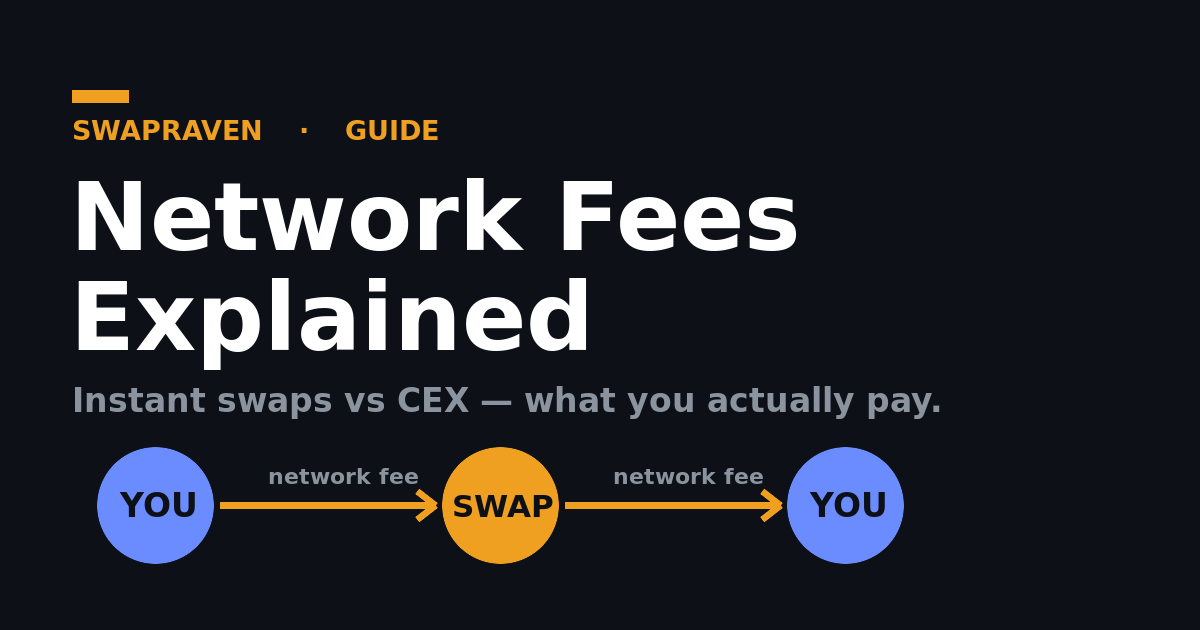
An instant swap is just two on-chain transactions wired together, with the exchange converting in the middle. Here's the full path of a swap, and where each network fee lands:
- You send your coins to the swap's deposit address. That's a normal on-chain transaction from your wallet — so you pay the network fee on the send, and you choose how much (your wallet lets you set the fee rate).
- The exchange converts your incoming coin to the outgoing coin at the quoted rate, taking its service fee / spread (this is the exchange's cut, distinct from any network fee).
- The swap sends the result to your address. That's a second on-chain transaction — and the swap pays that payout network fee, which it accounts for inside the quote you were shown.
So a single swap involves two network fees (your deposit + the swap's payout) plus the exchange's service margin. The good news: the payout fee is baked transparently into the quote, so when you compare exchanges on SwapRaven you're comparing the all-in amount you'll actually receive.
Network fees: instant swap vs CEX — how they really differ
A centralized exchange follows a different model, and it's where hidden costs creep in:
- On an instant swap: you pay the real network fee to send your deposit (and you control that rate from your wallet), and the swap passes through the actual payout network fee in the quote. No account, and no fixed withdrawal markup. The fees track the true on-chain cost.
- On a CEX: you deposit (pay a network fee to get funds in), trade internally (their trading-fee, settled off-chain in the exchange's own ledger), then withdraw to your wallet — and the withdrawal carries a CEX-set withdrawal fee that is often a flat markup over the true network cost. Many exchanges charge the same fixed withdrawal fee whether the network is calm or congested, and pocket the difference. Add KYC, identity collection, and the risks that come with it.
The net effect: an instant swap exposes the genuine network economics and lets you control your send fee, while a CEX abstracts the network away and frequently marks up withdrawals. That difference is a big part of why people choose instant swaps over centralized exchanges.
What network fee should you pay on an instant swap?
You directly control exactly one fee: the send (deposit) fee from your own wallet. The golden rule is to pay enough that your deposit confirms comfortably within the swap's quote window — because if your deposit sits unconfirmed too long, a locked quote can expire and you may receive a floating rate set later, or have to start over. Underpaying to save a few cents is a false economy here.
- Bitcoin: check the live fee market on mempool.space and pick a sats/vByte rate that matches the "next few blocks" estimate. When the mempool is calm you can go low; when it's busy, pay up so your deposit confirms before the quote window closes. Don't send the rock-bottom rate for a time-sensitive swap.
- Ethereum: let your wallet suggest gas and accept a normal priority tip; if gas is spiking, wait for a calmer moment rather than overpaying, since gas can swing dramatically within a day.
- Solana: fees are negligible, but add a small priority fee during congestion so your transaction isn't dropped and need re-sending.
A few more habits that save money and headaches:
- Prefer a fixed-rate quote when the exact output matters, so a slow confirmation can't move the amount on you while your fee-savings gamble plays out.
- Leave fee headroom — never send your entire balance to the dust, or you won't be able to cover the next transaction (especially on account-based chains where you pay fees in the native coin).
- Batch when you can. One larger swap incurs the two-network-fee structure once; ten tiny swaps pay it ten times, so small swaps lose a bigger percentage to fees.
- Don't swap straight from a CEX. Withdraw to your own wallet first, then swap — it avoids AML headaches and keeps you in control of the send fee. (See the safety notes in our SOL→BTC guide.)
Comparing the all-in cost
To compare fairly, add up every layer rather than fixating on one number:
- Instant swap, all-in: your send network fee + the exchange's service fee/spread + the payout network fee (already inside the quote). No account, no withdrawal markup.
- CEX, all-in: deposit network fee + trading fee + a withdrawal fee that's often marked up over the real network cost + the time and exposure of KYC.
Because instant swap quotes already net out the payout network fee, the simplest way to shop is to compare what you'll actually receive across exchanges. That's exactly what SwapRaven is built for: it grades no-KYC instant swaps and lets you compare live rates and fees side by side, so you can see the all-in cost before you send a single satoshi. For a sense of how much volume flows through these venues, see the instant swap industry by volume.
Pay the right fee, keep more of your crypto
Network fees aren't a mystery once you see the model: you're paying the blockchain to settle your transaction, and a swap is simply two of those transactions with a conversion in the middle. Instant swaps keep that cost honest and in your hands; CEXs tend to bury it in marked-up withdrawals. Understand what each fee pays for, set your send fee to confirm inside the quote window, and compare the all-in amount you'll receive. When you're ready, browse SwapRaven to compare no-KYC instant swaps on trust, rate, and fees — and keep more of your crypto in your own wallet.
Comments (0)
Leave a comment