
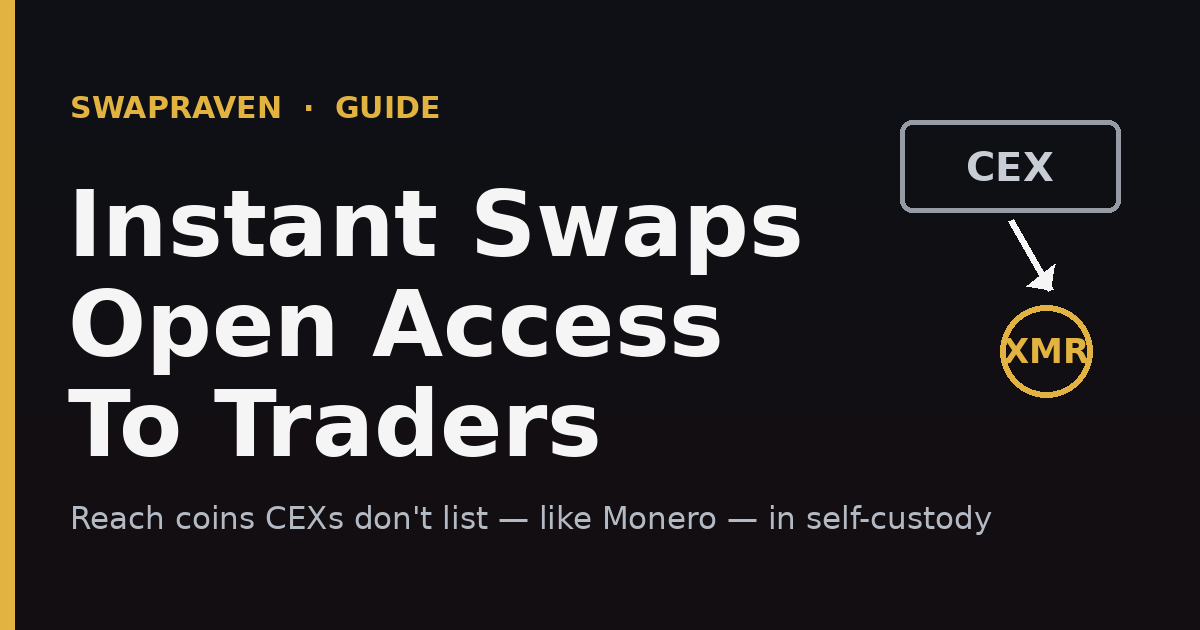
Centralized exchanges only list a fraction of the coins that exist, and the list keeps shrinking as platforms delist assets for legal, regional, or compliance reasons. Instant swap exchanges remove that ceiling. They let any trader reach the long tail of coins — including privacy coins like Monero — and move funds straight into a wallet they actually control. This article explains how instant swaps open access for traders, and walks through the simple workflow of turning Bitcoin or Ethereum from a centralized exchange into the coin you really want.
Why centralized exchanges limit your coin access
A centralized exchange (CEX) is a business that decides which assets it will support. That decision is shaped by far more than user demand:
- Delistings. Coins get removed when regulations change or a listing becomes a liability — privacy coins in particular have been delisted from many major venues.
- Regional restrictions. The same exchange often offers different coins depending on where you live.
- Listing politics and fees. Getting listed can be slow and expensive, so smaller or newer projects simply never appear.
- Compliance risk. Anything that complicates KYC/AML reporting is the first to go.
The result is that the coin you want may never be available on the exchange you already use — no matter how popular it is with the community.
Instant swaps give you the long tail of coins
An instant swap exchange isn't bound by those constraints. Because it performs a single, address-based conversion and never holds a balance for you, it can support a much wider range of assets and pairs. Aggregator-style swaps go even further by routing your trade to whichever provider has the coin and the best rate. In practice that means access to hundreds of coins a typical CEX will never list — and no account, and no KYC by default.
New to the concept? Start with our explainer: What is an Instant Swap Exchange?
The CEX → instant swap → self-custody workflow
Most traders already own some Bitcoin or Ethereum bought on a regulated exchange. That liquidity is the on-ramp; an instant swap is the bridge to everything else. The flow looks like this:
- Buy BTC or ETH on a CEX you already use, such as Coinbase or Kraken.
- Withdraw that BTC or ETH to a wallet you control — not leaving it on the exchange.
- Open an instant swap, choose your BTC/ETH as the input and the coin you want as the output.
- Paste the receiving address of your own private wallet and send the deposit.
- Receive the new coin directly in self-custody — the swap service never holds it.
In a few minutes you've gone from a coin your exchange supports to one it doesn't, and the result sits in a wallet only you control.
Why this matters for Monero and privacy coins
Monero (XMR) is the clearest example. It has been removed from several large exchanges, yet demand for private, fungible money hasn't gone anywhere. Instant swaps are now one of the main ways people acquire it: withdraw BTC or ETH from your CEX, swap it for XMR, and have it land in your own Monero wallet. No order book, no account, and nothing reported back to a trading platform.
Cross-chain access without bridges
Because instant swaps are cross-chain by design, they also solve a problem DEXs can't. A decentralized exchange usually trades within a single network, so reaching an asset on another chain means juggling bridges, wrapped tokens, and gas on multiple networks. An instant swap collapses all of that into one step — send Bitcoin, receive a coin on a completely different chain, delivered to your address.
Self-custody and privacy by default
Access isn't only about variety — it's about control. Every coin you acquire through an instant swap goes straight to your wallet, so you're never trusting a third party to hold it. And because most swaps require no account, you reduce how much of your trading activity is tied to your identity. For traders who value sovereignty, that combination of more coins and more control is the whole point.
What to keep in mind
- Compare rates. Spreads vary between providers; fixed rates lock your quote, floating rates can be cheaper but move.
- Check limits. Minimum and maximum amounts differ by coin and service.
- Mind withdrawal rules. Some CEXs flag or limit withdrawals to certain coins or addresses — withdraw BTC/ETH, then swap.
- Do your due diligence. Read the service's policies, fees, and reviews before sending funds.
Find vetted instant swaps on SwapRaven
The catch with so much choice is knowing which services are trustworthy. That's what SwapRaven is for. We grade instant swap exchanges and aggregators on trust, fees, KYC and AML posture, supported coins, and privacy features like Tor and I2P access — so you can find a swap that lists the coin you want and treats your funds and data the way you expect. Browse the directory to reach the coins your exchange won't list, and keep them in your own wallet.
Comments (0)
Leave a comment