
Today it feels normal to swap one cryptocurrency for another in minutes without an account — pick two coins, paste an address, send, receive. But that model had to be invented, and it arrived years after the first crypto exchanges. This is a short history of the instant swap exchange: where it came from, who pioneered it, and how it evolved into the no-KYC, address-based swaps catalogued on SwapRaven today.
Before instant swaps: custodial order books
The earliest crypto exchanges were custodial order-book platforms. You created an account, deposited funds into the exchange's wallets, placed buy/sell orders against other traders, and withdrew later. It worked, but it meant signing up, trusting the exchange to hold your coins, and — increasingly — completing identity verification. The collapses of that era made the downside obvious: when the exchange controls the keys, your funds are only as safe as the company.
The breakthrough: no-account, address-based swaps
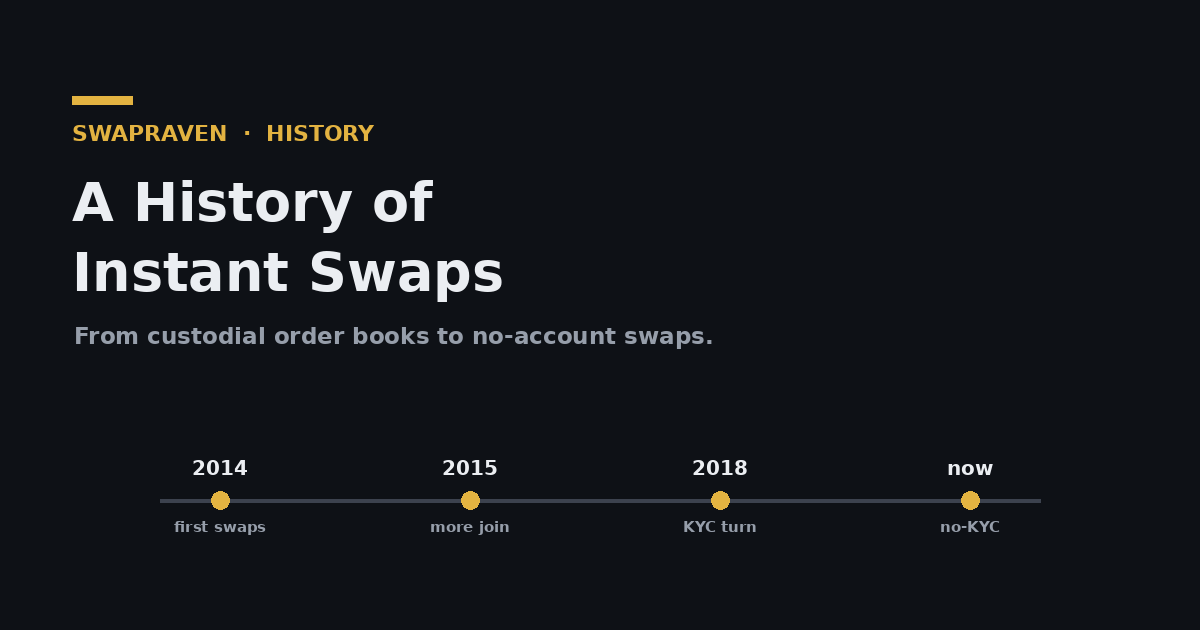
The instant swap model emerged around 2014, pioneered by ShapeShift (founded by Erik Voorhees). Its idea was radical for the time: no account, no order book, no holding your balance. You simply chose an input and output coin, sent your deposit to a one-time address, and the service sent the converted coins straight back to your wallet. A swap was a single, self-contained conversion — not a balance sitting on a platform. Early on, there was no signup and no KYC; it was the closest thing to "cash exchange" for crypto.
Others followed quickly. Changelly launched in 2015, and over the next few years a wave of "instant exchange" services appeared, popularizing the category and adding more coins and pairs.
The KYC turn — and the demand it created
As the industry grew, regulatory pressure followed. The most symbolic moment came in 2018, when ShapeShift introduced mandatory membership and identity verification — the original no-account swap now asked who you were. Other instant exchanges added AML screening and began flagging or holding transactions they considered risky.
This created a clear split in the market. Users who valued the original promise — swap without an account, without handing over ID — looked elsewhere, and a new generation of no-KYC instant swaps grew to serve them. The category didn't die with the KYC turn; it forked.
What came next: aggregators, privacy, and decentralization
- A new wave of no-KYC swaps. Through the late 2010s, many address-based instant swaps launched keeping the no-account model, often with privacy-coin support and Tor access.
- Aggregators. Rather than quoting a single provider, aggregator services began comparing rates across many swap backends and routing each trade to the best one — more reach and better pricing from one interface.
- Privacy-coin focus. As big exchanges delisted coins like Monero, instant swaps became one of the main ways to acquire them — they never needed to "list" a coin the way an order book does.
- Decentralization and atomic swaps. ShapeShift itself eventually pivoted toward a decentralized model, and trustless atomic swaps and DEX aggregation pushed the idea further — trading without any custodian at all.
Where it stands today
The instant swap is now a mature category: address-based, no-account, no-KYC-by-default conversions delivered straight to your wallet, alongside aggregators that shop multiple providers and a healthy ecosystem of privacy-friendly options. The original 2014 insight — that a swap should be a single conversion you control, not a balance on someone's books — turned out to be durable. (For how they work today, see What is an Instant Swap Exchange?)
Find today's instant swaps on SwapRaven
The category has come a long way from a single pioneer in 2014 to a broad market of swaps and aggregators. SwapRaven catalogues today's instant swap exchanges and grades them on trust, fees, supported coins, and KYC/AML posture. Browse the directory to find a vetted, no-KYC instant swap — the modern descendant of that original no-account idea.
Comments (0)
Leave a comment